
1. Why Lose Weight?
As a fatty weighing 200 jin (100 kg), I’ve actually been thinking about losing weight for a long time… Unfortunately, I never put it into action….
There are quite a few reasons, of course, like gym intimidation, working out being boring, starving to lose weight, exercising being tiring,
having to resist the temptation of delicious food… and so on. But when you sum it all up, it basically comes down to laziness… ~~~
But in recent years, as I’ve gotten older and my basal metabolic rate has decreased, I can clearly feel that I’m getting fatter,
my belly is getting bigger, and I’m feeling weaker and weaker. Sitting for a day feels exhausting, and even going out for a walk feels tiring…
The main issue isn’t just the visible fat on the outside, but the invisible visceral fat inside the body.
That is the real killer of health. Although I don’t think being a little overweight is a huge problem, I really don’t want to kick the bucket too early…
So I decided to start implementing a weight loss plan. This is also the first time in my life that I’ve started exercising… Sweat… ~~~
I just hope my weight loss process won’t be as painful as I’ve heard. I need to work hard to create a happy weight loss plan.
2. What is Happy Weight Loss?
- Not feeling bored.
- No need to starve.
- Not feeling tired during daily activities.
3. What Preparations Are Needed?
- Understand your body as much as possible.
You need to understand how the complex human body works, how food is processed after ingestion, how muscles grow, etc.
Of course, this also includes various data points about your own body, including height, weight, body fat percentage, basal metabolic rate, muscle condition in various parts, etc. - Understand the exercises you plan to do.
Whether by reading books, searching online, asking experienced friends, or hiring a coach,
learn what aerobic exercise is, what anaerobic exercise is, and how to define whether something is aerobic.
Figure out the function, principles, pros and cons, standard form, and potential injuries of an exercise.
Form must be standard; otherwise, not only will you fail to get a workout effect, but you might also injure yourself. - Find a gym that is convenient to get to and has a nice environment.
Convenience is very important; being on your commute home from work or within walking distance of your home meets the requirements.
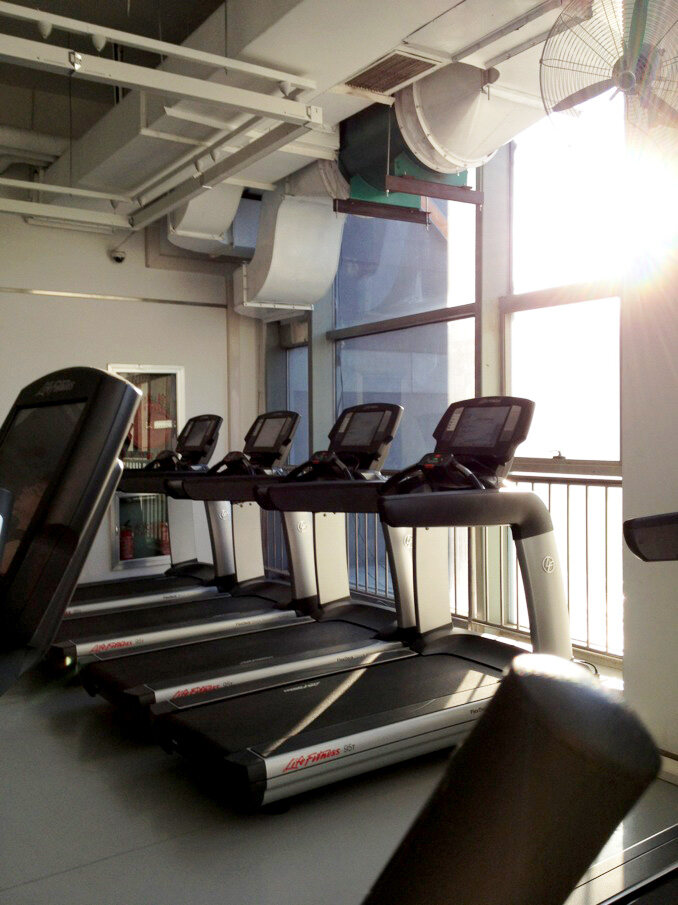
As for the environment, it should naturally have bright lighting, fresh air, and a comfortable temperature. It’s even better if the view is relatively open (for example, having large floor-to-ceiling windows).
Of course, the newer the equipment and the more features, the better. At the gym I go to, both the treadmills and stationary bikes can connect directly to an iPhone to use Nike+ to automatically record fitness data.
I can check it online directly when I get home, which is obviously much more convenient and provides a lot more motivation.
4. What is the Plan?
First, adhere to the following principles for fitness training:
- Absolutely no injuries allowed.
- Combine aerobic and anaerobic exercises to reduce fat while building muscle.
- Adjust promptly based on personal conditions.
Next, let’s talk about heart rate. The formula is as follows:
Lower limit of aerobic zone:
Male: (220 – Age – Resting Heart Rate) * 0.7 + Resting Heart Rate
Female: (200 – Age – Resting Heart Rate) * 0.7 + Resting Heart Rate
Upper limit of aerobic zone:
Male: (220 – Age – Resting Heart Rate) * 0.85 + Resting Heart Rate
Female: (200 – Age – Resting Heart Rate) * 0.85 + Resting Heart Rate
Only values between these two limits constitute aerobic exercise.
Below the lower limit is cardio recovery training, and above the upper limit is anaerobic exercise.
When choosing aerobic equipment, I considered running, cycling, and the elliptical machine.
Although running burns the most energy, it is too easy for a fatty to get injured, so I’ll consider it after losing some weight.
Stationary bikes seem pretty good; the exercise volume is moderate, there is less pressure on the knees, and heart rate can be monitored at any time.
The elliptical machine is also good with zero impact on the knees, so I’ll alternate between it and the bike~~~~
Since I haven’t exercised in years, I have absolutely no idea about my physical condition… Jumping straight into high-intensity training might kill me…
So, at the beginning, the focus is mainly on testing the waters + recovering cardiopulmonary function… Thus, I plan to do recovery exercises for the first month.
Month One
Aerobic: 45 minutes, with a 5-minute warm-up at the start and a 5-minute cool-down at the end. Intensity and speed should keep the heart rate around the lower limit of the aerobic zone; initially, it can be below the lower limit.
Anaerobic: 2 sets of 10 reps per machine. Choose lighter weights where you only start feeling it during the second set… Mainly to get familiar with the equipment.
Month Two
Aerobic: 45 minutes, with a 5-minute warm-up at the start and a 5-minute cool-down at the end. Intensity and speed should keep the heart rate slightly above the lower limit of the aerobic zone.
Anaerobic: Focus on one body part per day—arms/chest/back. Use 2-3 machines per body part, doing 4 sets of 10 reps per machine.
Legs and abs will be added later once weight drops.
Diet Control:
For a foodie, strictly forbidding tasty food is absolutely unacceptable. Moreover, dieting reduces basal metabolism along with weight, so it doesn’t have much practical significance.
Diet control is not starvation; it is reasonably changing previous eating habits based on the body’s needs.
Reduce fatty and starchy foods, and increase intake of protein, water, vegetables, and fruits~~~~
Overall, this hasn’t negatively affected my enjoyment of food~~~~~
5. Execution Status
As mentioned in previous blog posts, my biggest fear was lacking motivation, getting bored, and failing to stick with it.
But the reality is that the daily aerobic session has become the time when I listen to music most attentively—it feels great.
Also, moving around every day makes me feel much more energetic than before, and I don’t feel tired at all anymore.
I have now successfully completed the first month’s plan, lost 6 jin (3 kg), and have just started executing the second month’s plan.
I bought a scale that measures body fat, and I can clearly see that body fat has decreased and basal metabolism has increased after working out.
I also made a chart to record my physical condition and workout details daily.
Actually, going to the gym every day makes the cost of fitness incredibly low—less than 5 yuan a day, plus air conditioning. Even if I just went to take a shower, it would be worth it~~~
This is just the first post about weight loss; there will be a second and third one later, haha.
Finally, here is a very famous fitness primer from Zhihu,
http://www.zhihu.com/question/20687290/answer/15853608
and why dieting doesn’t work for weight loss:
http://www.zhihu.com/question/20588656/answer/15566260


Support